The report was supposed to have been kept classified, but was somehow leaked to the media through a senior military official. It pointed to the President and his staff for ordering the MPs guarding the detainees to employ any means necessary, and any extent of abuse to gain intelligence from the prisoners regarding terrorism. Although Rumsfeld and many commanding officers denied seeing any of the photos of abuse before the release of the report, Taguba felt that many of them had indeed seen the pictures, and had knowledge of the extent of the torture, but made no attempt to stop them or inform the President or the appropriate Senate committee of the activities.
Showing posts with label Abu Ghraib. Show all posts
Friday, November 18, 2011
Antonio Taguba and His Report, May 2004
In March 2004, General Antonio Taguba was assigned to investigate the alleged abuses at Abu Ghraib. Although many top presidential administration officials, including Secretary of Defense Rumsfeld, denied having any knowledge of the abuse prior to the release of the report. However, Taguba's report showed that the commands for the abuse had to have been handed down from top military commanders.
The report was supposed to have been kept classified, but was somehow leaked to the media through a senior military official. It pointed to the President and his staff for ordering the MPs guarding the detainees to employ any means necessary, and any extent of abuse to gain intelligence from the prisoners regarding terrorism. Although Rumsfeld and many commanding officers denied seeing any of the photos of abuse before the release of the report, Taguba felt that many of them had indeed seen the pictures, and had knowledge of the extent of the torture, but made no attempt to stop them or inform the President or the appropriate Senate committee of the activities.
After Taguba's report was released, he was ostracized by military officials and the Presidential administration. A couple of months later, he was demoted to an inferior position in a low-ranking office at the Pentagon, essentially so that officials could keep an eye on him. Knowing that his career was at a dead-end, Taguba retired shortly after. Although military officials ignored him after he authored the report, Taguba has been heralded by many as a pioneer for telling the truth about the extent of the abuse, knowing that his career and military future were on the line. Summed up best in his own words, "If I lie, I lose. And, if I tell the truth, I lose."
The report was supposed to have been kept classified, but was somehow leaked to the media through a senior military official. It pointed to the President and his staff for ordering the MPs guarding the detainees to employ any means necessary, and any extent of abuse to gain intelligence from the prisoners regarding terrorism. Although Rumsfeld and many commanding officers denied seeing any of the photos of abuse before the release of the report, Taguba felt that many of them had indeed seen the pictures, and had knowledge of the extent of the torture, but made no attempt to stop them or inform the President or the appropriate Senate committee of the activities.
Monday, November 14, 2011
The Location, Atmosphere & Situation at Abu Ghraib by Sept. 2003
When the 372nd Military Police Company arrived at Abu Ghraib prison in September of 2003, the conditions within the prison were deplorable. Painted with pictures of Hussein, and remains of human bodies scattered around, the soldiers stationed there were less than eager to be in charge of watching and regulation the prisoners detained there. Described as "a desert bowl of misery," the heat index could reach over 130 degrees. The smell of sweat, feces, urine and decay ran rampant, and the prison could go days without electricity or running water.
Former Brigadier General Janis Karpinski, commander of U.S. military detention operations, says that resources and back-up were requested numerous times, not only at Abu Ghraib, but at other prison facilities also. The 372nd MP company was trained to support combat operations, not act as prison guards for thousands of Iraqi citizens. They had received no training in corrections, and upon learning that this would be their mission, their morale plummeted. The prison was the most attacked U.S. position in Iraq, and was positioned next to the most dangerous road in Iraq.
Abu Ghraib prison
Former Brigadier General Janis Karpinski, commander of U.S. military detention operations, says that resources and back-up were requested numerous times, not only at Abu Ghraib, but at other prison facilities also. The 372nd MP company was trained to support combat operations, not act as prison guards for thousands of Iraqi citizens. They had received no training in corrections, and upon learning that this would be their mission, their morale plummeted. The prison was the most attacked U.S. position in Iraq, and was positioned next to the most dangerous road in Iraq.
Throughout July and August 2003, the prison only held about 1,000 prisoners and the atmosphere was fairly stable. However, due to mass round-ups and slow releases, the population soared to over 6, 000 by the end of September. With less than 300 MPs, the ratio was 20:1. The lack of management, security and manpower would lead to crisis and scandal that would plague the 372nd MP Company, and destroy the credibility of the American Army.
Iraqi detainees at Abu Ghraib
The Geneva Conventions & The War on Terror
The Geneva Conventions were a set of rules and standards that regulated and governed the treatment of prisoners of war, and civilians who were detained that were not considered dangerous. This agreement is between the United States and other countries around the world that have agreed upon the terms of the conventions. The most important of the conventions is the third Article, which states that "Protected persons are entitled, in all circumstances, to respect for their persons, their honour, their family rights, their religious convictions and practices, and their manners and customs. They shall, at all times, be humanely treated, and shall be protected, especially against all acts of violence or threats thereof and against insults and public curiosity," (Fourth Geneva Convention).
The signing of the Geneva Conventions in 1949
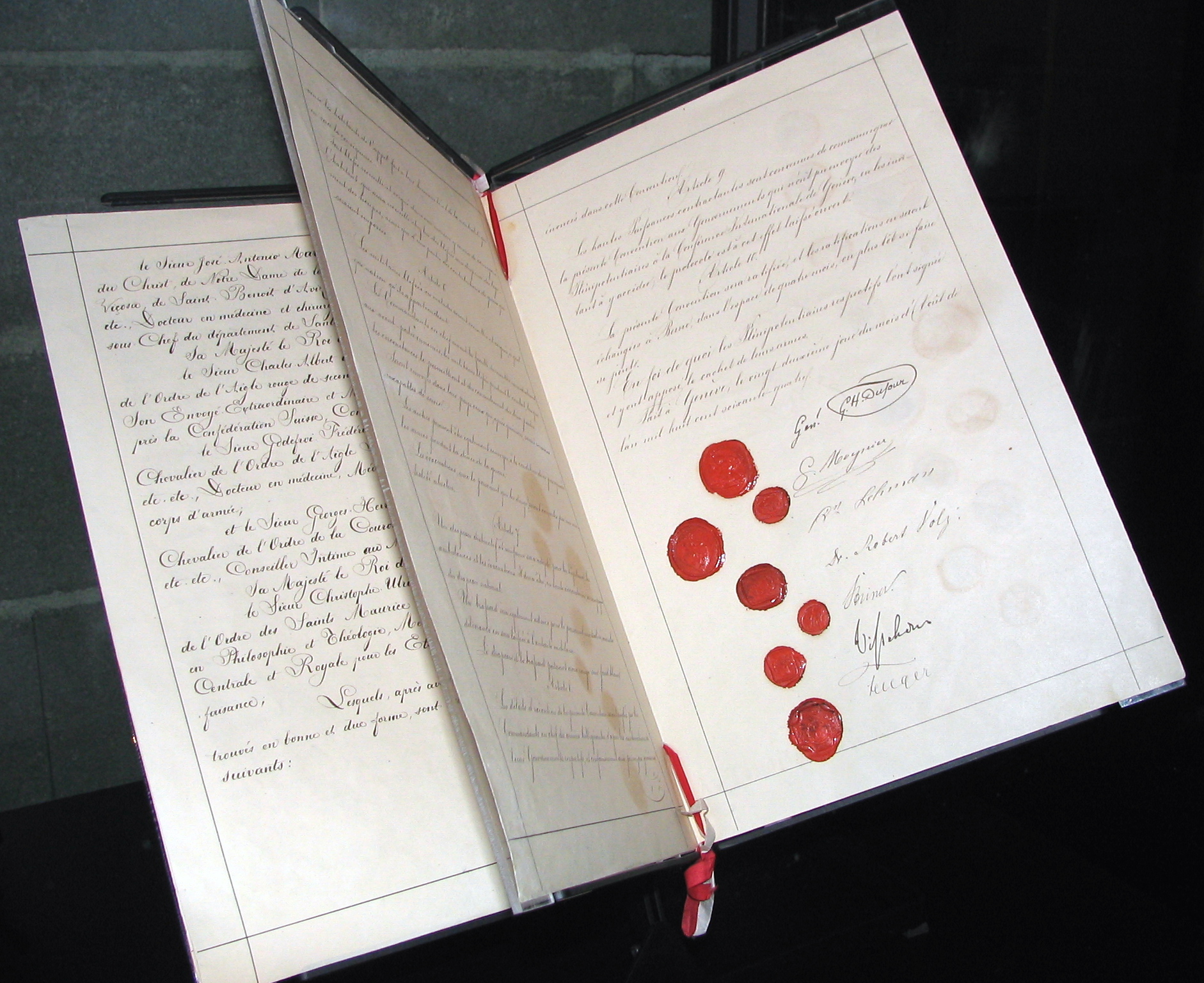
The original document from the1864 Geneva Convention
The Geneva Conventions are important to Americans because we try to hold our standards of treatment of prisoners of war higher than other countries. We want our soldiers to be treated humanely if they are captured, therefore, we try to hold this same principle true with prisoners of war we capture. These conventions became an issue during the war on Afghanistan in 2001. The Justice Department determined that they did not apply in the war against al-Qaeda because they did not sign or agree to the conventions, nor do they follow the rules of warfare. Because al-Qaeda targets and kills civilians, they do not deserve to be treated according to the principles of the Geneva Conventions.
The President's decision to disregard the Geneva Conventions
in Afghanistan drew outrage from the public
In early 2002, President Bush made the unprecedented decision that the standards of the Geneva Conventions would not hold up for the members of al-Qaeda during the war on terror in Afghanistan. Since the war was dependent upon intelligence gained from prisoners of war, the humane treatment of these detainees was critical and vital to the gathering of intelligence and eventual success of the war.
The Context of the Abu Ghraib Prison Scandal
In terms of the public view of the Iraq War in the summer of 2003, everything was going great. In May, President George Bush delivered his famous "Mission Accomplished" speech, which boasted that "Major combat operations in Iraq have ended. In the battle of Iraq, the United States and our allies have prevailed," (Ricks 145). This was not the case. No plans had been made for the post-war occupation of Iraq, no weapons of mass destruction had yet been discovered, and there was still much work to do in terms of rebuilding the country.
President Bush on the USS Abraham Lincoln
Although the White House only acknowledged isolated insurgent attacks in sporadic regions, the insurgency was starting to push full steam ahead. Enemy fighters used roadside car bombs to kill American convoys passing by, and pushed the US military to adapt new techniques to resist and survive the attacks. Due to little intelligence, and military leaders uninformed of an overarching plan, chaos ran rampant the military operations. Meanwhile, American soldiers stationed in Iraq starting losing their momentum and optimistic attitudes towards the war. They were not properly trained to detain and interrogate Iraqi insurgency members, and had no real background on how to depict enemies from civilians. This led to the mass roundup of thousands of Iraqi civilians, and transfer to Abu Ghraib, a small prison outside of Baghdad.
Abu Ghraib Prison
Political leaders called for interrogation to force intelligence out of prisoners, which would hopefully lead to less bombs, attacks and eventual deaths for the US military. General Sanchez approved harsh interrogation techniques, even harsher than the ones in current operation at Guantanamo Bay, to force intelligence out of the prisoners. "All of the Army's problems in Iraq in 2003-poor planning, clumsy leadership, strategic confusion, counterproductive tactics, undermanning, being overly reactive-came together in the treatment of prisoners," (Ricks 290). In an international scandal that would come to be known as simply "Abu Ghraib," American soldiers and military leaders would be harshly criticized and punished for the torturous attacks that happened to the human detained at this prison.
PFC Lynndie England abusing prisoners
Subscribe to:
Posts (Atom)